Who This Blog Is For: If you keep asking why is my lower back always tight and achy — even after all the stretching, rolling, and new chairs — this blog is for you. It speaks to people across North Knoxville, including Fountain City, Halls Crossroads, Powell, Corryton, and Heiskell, who do not have dramatic flare-ups so much as a dull, constant tension that never lets go.
It is a particular kind of wearing. Not the sharp catch that doubles you over, but the ache that is simply there: stiff standing up from the couch, tight getting out of the car, achy by the end of a workday whether you lifted anything or not. You stretch, get ten minutes of ease, then it tightens again. After months, stretching starts to feel like bailing a boat that keeps filling, and a fair question surfaces: if stretching were the answer, why hasn't it worked?
Quick Answer: A lower back that stays tight and achy is usually guarding: muscles holding steady tension to stabilize the spine, not stiffness you can stretch out. Your physician evaluates the recognized causes — muscle strain, disc or facet involvement, posture. A commonly overlooked contributor is alignment at the top of the spine, which shapes the compensation pattern keeping those muscles on.
A constantly tight lower back is less about flexibility than most people assume. Low back tension is a symptom, not a diagnosis, so why it lingers depends on what is driving it. Your physician evaluates the recognized causes: muscle strain, disc or facet involvement, sacroiliac irritation, and posture.
Here is what explains the stubbornness. Often, a chronically tight lower back is guarding: the muscles hold low-grade tension to stabilize a spine working harder than it should. Guarding is protective, and it does not release just because you stretch, because the muscles are doing it on purpose.
A commonly overlooked contributor to that guarding is alignment at the very top of the spine. When the upper cervical vertebrae sit slightly off, the body compensates to keep the head level, and the lower back often holds that compensation — which is why the tension keeps returning no matter how you stretch.
When back pain needs urgent care: Numbness or weakness in a leg, loss of bladder or bowel control, pain following a fall or accident, or back pain with fever or unexplained weight loss can signal something that needs prompt medical care. See a physician right away rather than waiting.
Stretching lengthens a muscle for a little while. But if it is guarding for a reason, working to stabilize an uneven foundation, it returns to guarding the moment you stand up and the demand comes back.
Think of a tent with one stake pulled out of line. Every rope on that side pulls tighter to keep it standing. You could loosen one by hand, but the moment you let go it snaps taut again, because the stake is still off. The rope is not the problem; it is responding to one. A lower back in constant tension works the same way: the muscles are the rope, the alignment is the stake. This is why chronic lower back tightness in Knoxville outlasts every stretch, cushion, and new office chair people try.
Left unaddressed, guarding becomes the body's new normal. One area stays tight, a neighboring area adjusts, and posture organizes around the pattern until the tension feels like how your back simply is. Poor sleep from never being comfortable adds another layer, and the ache deepens quietly.
For some people, this is why lower back stiffness in North Knoxville trails them for years, even after the stretches and ergonomic fixes. That is not a reason to stop what helps: movement, strengthening, massage, and medical care all have their place. The point is narrower: when the tightness never fully lets go, it is worth asking whether a structural contributor underneath has been looked at, since it sits outside a workup focused on the lower back.
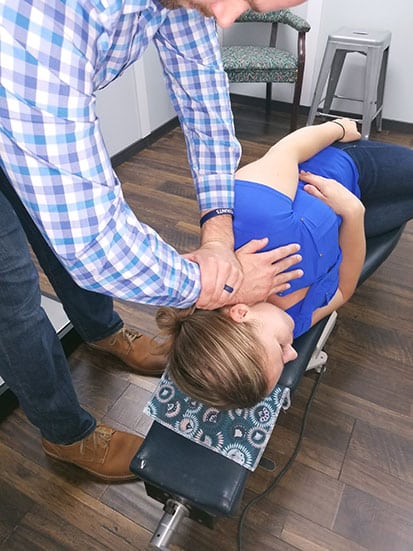
Upper cervical care focuses on the alignment of the top of the neck and how it relates to the rest of your posture. At Transcend Chiropractic, Drs. Connor and Leigh Davis use the NUCCA method — an imaging-guided approach that maps your anatomy before any gentle, low-force correction is made. No twisting, no popping.
The aim is not to chase the tight muscles but to support the structure so the lower back has less to brace against, giving them a reason to ease their guard. Many people find upper cervical care for back pain in Knoxville fits alongside the care they already receive, adding to it rather than replacing it.
If your lower back has been tight as long as you can remember, the most hopeful step is to stop fighting the muscles and look at what they are bracing against. Exploring upper cervical care gives your body a chance to work from a more balanced foundation, and addressing an upper-neck misalignment sooner may keep that pattern from quietly contributing to other issues down the road. Drs. Connor and Leigh Davis offer a gentle evaluation to see whether your alignment is part of the story, and welcome anyone looking for back pain help in Powell.
Schedule a consultation to take a steadier step.
Why is my lower back always tight even though I stretch?
Because a chronically tight lower back is usually guarding rather than short, stiff muscle. Stretching lengthens the muscle briefly, but if it is bracing to stabilize the spine, it returns to tension as soon as the demand comes back. The guarding eases when the thing it is bracing against is addressed.
Is a constantly tight lower back something to worry about?
Ongoing tightness is common and usually not dangerous, but it is worth evaluating rather than just enduring. See the red-flag signs above for when tightness or pain needs prompt medical care; short of those, a persistent pattern is worth having looked at.
Can the alignment of my neck really affect my lower back?
It can contribute. Alignment at the top of the spine influences how the whole structure balances, and the lower back often compensates for an imbalance above it. An unaddressed misalignment may be one factor in why the tension lingers — alongside, not instead of, the causes your physician evaluates.
Why does my lower back feel worse in the morning?
A back that guards all day often does not fully release overnight, so you wake up already stiff. Sleep position and mattress support play a role too. If mornings are consistently the worst, it is worth mentioning to whoever evaluates your back.
Does upper cervical care replace seeing my doctor about back pain?
No. It is meant to work alongside your physician's care. Your doctor evaluates and manages conditions like disc and facet involvement; upper cervical care simply looks at a structural contributor many workups do not examine.
Will stretching or strengthening still help?
Often, yes — movement and strengthening are valuable and worth continuing. The point is not to stop them but to recognize that if tightness keeps returning, something underneath may be keeping the muscles on guard, and that piece is worth addressing too.
How long might it take to notice a change in the tightness?
It varies from person to person, depending on how long the pattern has been present and what else is involved. Because the body unwinds a long-held pattern gradually, many people notice changes over weeks rather than days. Your care plan is tailored to what your evaluation shows.
Is upper cervical care gentle enough if my back is already sore?
The NUCCA approach uses precise, low-force corrections guided by imaging rather than forceful twisting, which many people find reassuring when their back is already tender. As with any care, an evaluation comes first to determine whether you are a good candidate.
To schedule a consultation with Transcend Chiropractic, call our Knoxville office at 865-448-7933. You can also click the button below.

If you are outside of the local area you can find an Upper Cervical Doctor near you at www.uppercervicalawareness.com.