Who This Blog Is For: If you keep wondering why vertigo makes you so tired even on the days the room holds still, this blog is for you. It speaks to people across North Knoxville — Fountain City, Halls Crossroads, Powell, Corryton, and Heiskell — who brace for the spinning but never expected the exhaustion that trails it, worn out in a way that is hard to explain to anyone who has not felt it.
Here is what rarely gets said out loud: vertigo episodes are sometimes frightening, but the tiredness is what wears you down. You get through a spell, steady yourself, then spend two days feeling like you waded through wet concrete — foggy, flat, drained, even though nothing is spinning. On the good days you brace for a flare that does not come, and that quiet watchfulness costs something too. If you feel more tired than your life should make you, that is worth taking seriously — it usually points to a system working harder than you can see.
Quick Answer: Vertigo often leaves you tired because your balance system relies on constant input from the inner ear, eyes, and upper neck, and reconciling that input is demanding work. Your physician evaluates the recognized causes, such as BPPV, Meniere's, or vestibular migraine. A commonly overlooked contributor is alignment at the top of the neck, which shapes how cleanly that input arrives.
Vertigo is a symptom, not a diagnosis, so the tiredness has several sources. Your physician evaluates the recognized causes: benign paroxysmal positional vertigo (BPPV), inner-ear conditions like Meniere's or vestibular neuritis, and vestibular migraine.
When dizziness is an emergency: Sudden severe dizziness with double vision, slurred speech, one-sided weakness, a severe headache, or trouble walking can signal a stroke. Call 911 rather than waiting. This blog is about ongoing, recurring vertigo, not these warning signs.
Here is where the tiredness comes in. Your sense of balance is built from three streams of information — the inner ear, the eyes, and position sensors in the upper neck — blended into one steady picture. When those streams disagree, the brain works to reconcile them, and that runs quietly in the background all day. A commonly overlooked contributor is the alignment of the uppermost vertebrae, which shapes how cleanly the neck's share of that input arrives.
The spinning can hit while you are rolling over in bed or checking a blind spot. But the fatigue does not wait for an episode. It is there on the calm days too, the part people find hardest to explain.
Think of driving a car that pulls slightly to one side. You can keep it straight, but your hands never fully relax, and after an hour you are tired in a way a smooth drive would not. A balance system reconciling mismatched input works the same way. It holds you steady but never quite lets go, which is why a good day can still end with you flat on the couch by evening. The fog, heavy limbs, and short fuse are the cost of a system in overdrive, not a sign you are not trying hard enough.
Left unaddressed, this pattern compounds. Poor input leads to more guarding through the neck and shoulders, which feeds more mismatched signals back into the system and keeps the effort turned up. Broken sleep from never feeling quite steady adds another layer, and the fatigue slowly deepens.
For some people, this is why chronic vertigo in North Knoxville drains energy for years, and why vertigo and fatigue in Knoxville so often travel together. That is not a reason to stop the care you already have — vestibular therapy, maneuvers, and medical management all matter. The point is narrower: when the tiredness lingers, it is worth asking whether a structural contributor to the input has been looked at, since it sits outside a standard workup.
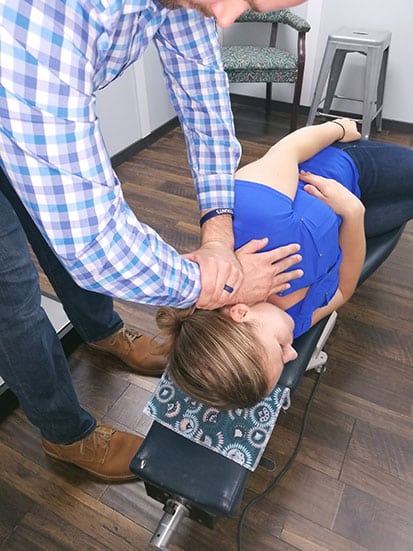
Upper cervical care focuses on the alignment of the top of the neck and how it relates to the balance input your brain receives. At Transcend Chiropractic, Drs. Connor and Leigh Davis use the NUCCA method — an imaging-guided, precisely measured approach that maps your individual anatomy before any gentle, low-force correction is made. No twisting, no popping.
The aim is not to chase the spinning but to support the structure so the neck's share of the input arrives more cleanly, giving the balance system less to reconcile. Many people find upper cervical care for vertigo in Knoxville fits alongside the medical care they already receive, adding to it rather than replacing it.
If the tiredness has become the heaviest part of living with vertigo, the most hopeful step is to stop pushing through it and look at what keeps your balance system in overdrive. Exploring upper cervical care gives that system a chance to work from cleaner input, and addressing an upper-neck misalignment sooner may keep those patterns from quietly contributing to other issues down the road. Drs. Connor and Leigh Davis offer a gentle evaluation to see whether your alignment is part of the story, and welcome anyone looking for vertigo help in Halls Crossroads.
Schedule a consultation to take a steadier, less tiring step.
Is it normal to feel exhausted between vertigo episodes?
It is very common. A balance system working to stay steady spends energy even when the room is not spinning, so many people feel drained on calm days. If the tiredness is persistent, it is worth having both the medical and structural pieces evaluated.
Can vertigo cause brain fog?
Many people notice foggy thinking alongside vertigo. When the brain is busy reconciling mismatched balance signals, fewer resources are left for focus and memory. The fog often eases as the underlying input steadies, though your physician should evaluate persistent cognitive changes.
Why am I tired even when I'm not dizzy?
Because the effort to stay balanced runs in the background whether or not you feel dizzy. A system compensating around inconsistent input never fully rests, and that quiet, all-day work is tiring on its own.
Can the alignment of my neck really affect balance and fatigue?
It can contribute. The upper neck holds position sensors the brain uses for balance, so alignment there shapes the quality of that input. An unaddressed misalignment may be one factor in why the fatigue lingers — alongside, not instead of, the causes your physician evaluates.
Does upper cervical care replace seeing my doctor or ENT about vertigo?
No. It is meant to work alongside their care. Your physician evaluates and manages conditions like BPPV, Meniere's, and vestibular migraine; upper cervical care simply looks at a structural contributor to the balance input that many workups do not examine.
What is the difference between vertigo, dizziness, and lightheadedness?
Vertigo is a false sense of spinning or motion. Dizziness is a broader sense of being off-balance, and lightheadedness is the feeling you might faint. They have different causes and are evaluated differently, so it helps to describe yours precisely to a clinician.
How long might it take to notice a difference in energy?
It varies from person to person, depending on how long the pattern has been present and what else is involved. Because the balance system steadies gradually, many people notice changes over weeks rather than days. Your care plan is tailored to what your evaluation shows.
Is upper cervical care gentle enough when I already feel unsteady?
The NUCCA approach uses precise, low-force corrections guided by imaging rather than forceful twisting, which many people find reassuring when they already feel off-balance. As with any care, an evaluation comes first to determine whether you are a good candidate.
To schedule a consultation with Transcend Chiropractic, call our Knoxville office at 865-448-7933. You can also click the button below.

If you are outside of the local area you can find an Upper Cervical Doctor near you at www.uppercervicalawareness.com.