Who This Blog Is For: Anyone whose had sciatica flare-ups after ordinary movement — bending to load the dishwasher, standing up from the truck, twisting to reach the back seat — will find this useful. It speaks to people across Knoxville, Fountain City, Halls Crossroads, Powell, and Corryton who have learned to brace before they bend, and who want to know why those movements set off pain for them and not the person beside them.
You know the moment. A small motion you have made ten thousand times, and then the line of fire down the back of your leg. The next week goes carefully — bad sleep, the yard waiting another weekend. It settles, until one morning you bend to tie your shoes and it starts over. Living around a leg you cannot trust is its own kind of tiring, and after enough rounds a fair question surfaces: if bending is the problem, why doesn't it happen to everyone?
Quick Answer: Sciatica flare-ups are usually set off by ordinary movements — bending, lifting, twisting, or standing after long sitting. Those movements are the spark, not the source. Your physician evaluates the recognized causes, such as disc herniation, spinal stenosis, or piriformis involvement. A commonly overlooked contributor is spinal alignment, which shapes how evenly the lower back absorbs load.
Sciatica is a symptom, not a diagnosis, so what sets off a flare-up and what makes it possible are different questions. Your physician looks first at the recognized causes: a lumbar disc herniation pressing on a nerve root, spinal stenosis, degenerative disc changes, sacroiliac involvement, and piriformis irritation.
The everyday sparks are familiar. Bending to lift something low. Twisting under weight. Standing up after a long drive. A cough, a sneeze, rolling over in bed. None of these create the underlying problem — they ask the lower back for load it was already struggling to distribute.
The overlooked contributor is how the spine is aligned from the top down. When the upper cervical vertebrae sit slightly off, the body compensates to keep the head level, and that compensation travels. The lower back absorbs load unevenly, which may be part of why an ordinary movement becomes a flare-up.
Two people bend to pick up the same box. One straightens up and forgets about it. The other spends four days on ibuprofen and a heating pad. The box did not change. The setup did.
A spine that distributes load evenly can absorb an awkward lift. A spine already holding a compensation pattern has less margin, so the same bend lands on tissue that has been working overtime for years. Chasing triggers alone only shrinks a person's life — the list of things to avoid grows while the margin narrows.
Your body will give up almost anything to keep your eyes level with the horizon. When the upper neck holds a small misalignment, the structures below adapt — a head tilt, one shoulder riding higher, a slight rotation through the pelvis.
A pelvis sitting a few degrees uneven changes how the lumbar spine loads with every step, every stair, every hour on I-640. That is a structural contributor to a compensation pattern, not a direct cause of nerve pain, and it is what a lumbar-focused workup is not looking at.

Compensation patterns reinforce themselves. One region tightens, a neighboring region takes up the slack, and posture organizes around the adaptation. Each flare-up leaves the surrounding muscles guarding a little more, narrowing the margin further.
For some people, this is why chronic sciatica in Knoxville shadows them for years — flaring, settling, flaring again — even after imaging has been reviewed and the obvious triggers managed. That is not a reason to abandon the care you already receive — physical therapy and medical management have their place. The point is narrower. When flare-ups keep returning to the same pattern, the structural setup underneath deserves a look too, because standard sciatica relief in Knoxville rarely includes an upper neck evaluation.
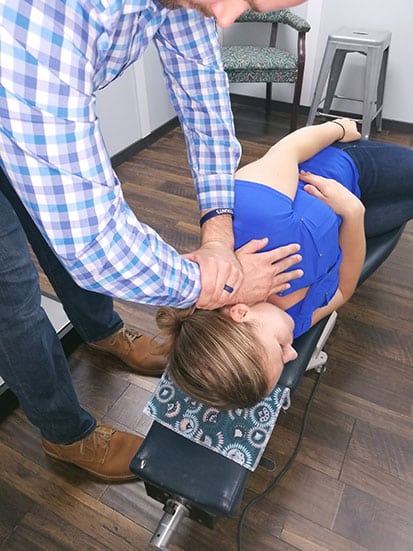
Upper cervical care for sciatica in Knoxville focuses on the alignment of the top of the neck and how it relates to the rest of your posture. At Transcend Chiropractic, Drs. Connor and Leigh Davis use the NUCCA method — an imaging-guided approach that maps your anatomy before any gentle, low-force correction is made. No twisting, no popping.
The aim is not to chase the leg pain, but to support the structure so your lower back carries load more evenly. Many people find that upper cervical care for sciatica in Knoxville fits alongside the medical care they already receive, adding to it rather than replacing it.
If you have spent years learning which movements to fear, the most hopeful step is to stop managing the sparks and look at what keeps making them possible. Exploring upper cervical care gives your body a chance to work from a more balanced foundation, and addressing an upper-neck misalignment sooner may keep compensation patterns from quietly contributing to other issues down the road. Drs. Connor and Leigh Davis offer a gentle evaluation to see whether your alignment is part of the story, and welcome anyone looking for sciatica help in Fountain City.
[Click Here to Schedule Your Initial Consultation with Our NUCCA Chiropractors in Knoxville]

What triggers a sciatica flare-up most often?
Bending, lifting, twisting under load, standing up after long sitting, and sudden coughing or sneezing are the most commonly reported sparks. Sleeping position and long drives come up often as well. These movements set off an episode rather than create the underlying condition.
Can a flare-up happen without an obvious trigger?
Yes. Some people wake up with it or notice it building through a normal day. When no clear spark is identifiable, it often means the margin was already thin — the lower back was carrying a compensation pattern that finally reached its limit.
Why do my sciatica flare-ups keep coming back?
Recurring episodes usually mean the underlying driver has not been fully settled. Each flare-up can also leave surrounding muscles guarding, which narrows tolerance for the next ordinary movement. Both the medical and structural pieces are worth evaluating.
Can the upper neck really play a role in sciatica?
It can contribute. Alignment at the top of the spine influences how the pelvis and lower back distribute load, so an unaddressed misalignment may be one factor in why episodes keep returning — alongside, not instead of, the recognized causes your physician evaluates.
How would I know if my sciatica is connected to my alignment?
Clues can include a past head or neck injury, one hip or shoulder that consistently sits higher, uneven shoe wear, lingering neck tension, or sciatica that keeps returning after imaging has come back unremarkable. None of these confirms an alignment link on its own. A focused upper cervical evaluation, which measures posture and alignment rather than examining the lumbar spine alone, is the clearest way to find out.
Does upper cervical care replace seeing my doctor about sciatica?
No. It is meant to work alongside your physician's care. Your doctor evaluates and manages conditions like disc herniation and spinal stenosis; upper cervical care simply looks at the structural contributor many workups overlook.
Is it sciatica, or could it be something else?
Leg pain can also come from piriformis irritation, sacroiliac joint involvement, or referred pain from the lower back without nerve involvement. They can feel similar and are managed differently. A clinician can help tell them apart, and it is worth knowing which one you are dealing with.
Is upper cervical care gentle enough if I am already in pain?
The NUCCA approach uses precise, low-force corrections guided by imaging. As with any care, an evaluation comes first to determine whether you are a good candidate.
To schedule a consultation with Transcend Chiropractic, call our Knoxville office at 865-448-7933. You can also click the button below.

If you are outside of the local area you can find an Upper Cervical Doctor near you at www.uppercervicalawareness.com.