

Reading Time: 6 minutes | Who the Blog is For: Residents from Knoxville and neighboring areas experiencing dizziness, anxiety, neck issues, and seeking natural solutions through upper cervical care
When patients first visit our Knoxville practice, many arrive feeling frustrated and disconnected from their own bodies. They've often been dealing with symptoms that seem unrelated—dizziness that makes them grip handrails, anxiety that appears out of nowhere, neck tension that never fully goes away, and an overall sense that something just isn't right.
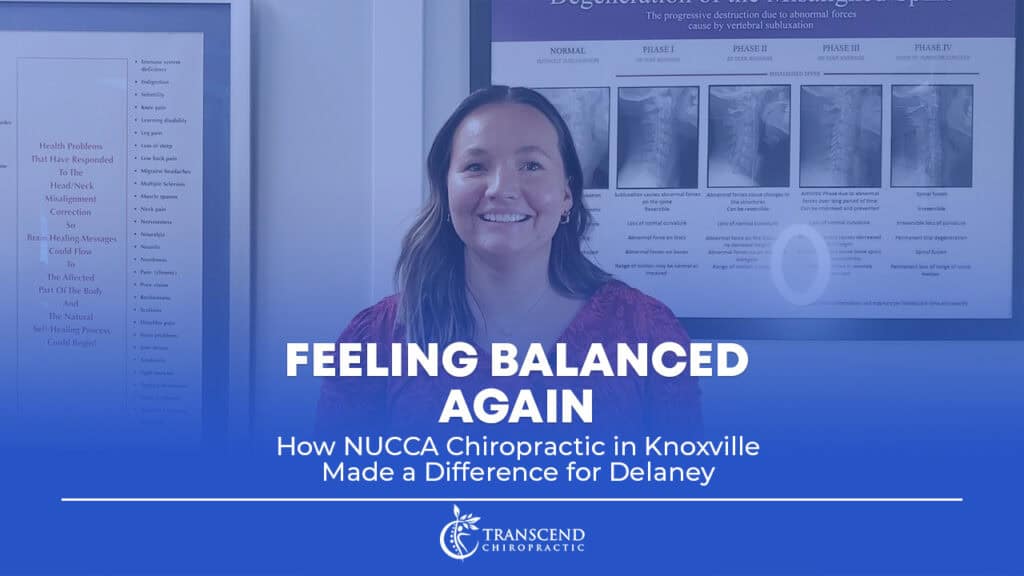
This was exactly the situation for Delaney. She is one of our patients who began NUCCA care in Knoxville a few years ago. Her story illustrates something we see regularly at Transcend Chiropractic: how addressing atlas alignment can create profound changes that extend far beyond what patients initially expect.
Before beginning upper cervical care, Delaney was dealing with several challenging symptoms that were significantly impacting her daily life. Dizziness was a constant companion, creating uncertainty about simple activities and making her feel unsteady throughout the day. She experienced frequent anxiety that seemed to come from nowhere, leaving her feeling on edge and unable to fully relax.
Like many of our patients, Delaney also struggled with persistent neck issues—tension and discomfort that never seemed to fully resolve, regardless of what she tried. But perhaps most frustrating was an overall sense of imbalance throughout her life, a feeling that her body wasn't functioning as it should.
What makes her story particularly compelling is that she didn't initially connect these various symptoms. The dizziness seemed like one problem, the anxiety another, and the neck issues yet another separate concern. This fragmented view of her health challenges is something we encounter frequently—patients don't realize that seemingly unrelated symptoms can actually stem from the same structural issue.
After beginning NUCCA care in Knoxville, Delaney committed to consistent treatment over an extended period. This patience and persistence proved crucial, as upper cervical healing often happens gradually, with improvements building upon each other over time.
Within the first several months of care, she began noticing changes in her dizziness levels. The episodes became less frequent and less severe, allowing her to move through her day with greater confidence and stability. Activities that had previously felt risky or uncomfortable became manageable again.
As her treatment continued into the second year, the improvements became more pronounced. The dizziness that had once been a daily struggle decreased tremendously, transforming from a constant concern to an occasional and minor inconvenience.
But perhaps the most surprising discovery was the dramatic improvement in her anxiety levels. This was something she hadn't expected when she first sought treatment for dizziness and neck problems. The connection between her upper cervical alignment and her anxiety wasn't something she had considered, making the improvement all the more remarkable and eye-opening.
The neck issues that had troubled her for so long also began to resolve, contributing to an overall sense that her body was finally working in harmony rather than fighting against itself.
One of the most striking aspects of Delaney's journey was her surprise at discovering the connection between her upper cervical alignment and her anxiety levels. This reaction is completely understandable—most people don't realize how intimately connected the atlas (the top bone of the spine) is to neurological function and emotional regulation.
The atlas sits at the junction between the skull and spine, protecting the brainstem—the command center that controls many of your body's automatic functions. When the atlas is misaligned, it can create interference with brainstem function, affecting everything from balance and coordination to stress response and emotional regulation.
Your brainstem houses important centers that help regulate your fight-or-flight response. When there's structural interference in this area, it can leave your nervous system in a heightened state of alert, contributing to feelings of anxiety and unease that seem to have no clear trigger.
This neurological connection explains why addressing atlas alignment can have such far-reaching effects on seemingly unrelated symptoms. When we restore proper position to the atlas, we're not just addressing neck pain or dizziness—we're helping to optimize the function of your entire nervous system.
What makes Delaney's story particularly illustrative is how her improvements created a positive ripple effect throughout her life. As her physical symptoms decreased, her confidence increased. As her anxiety levels dropped, she was able to engage more fully in activities and relationships she enjoyed.
This cascading improvement is something we observe regularly when atlas alignment is properly restored. Patients often report that they feel more like themselves again—more present, more stable, and more optimistic about their future.
The phrase "the future is bright" that Delaney used captures something essential about successful upper cervical care. When your nervous system is functioning optimally, when dizziness isn't limiting your activities, when anxiety isn't clouding your thoughts, and when neck tension isn't creating constant discomfort, life opens up again. Possibilities that seemed closed off become available once more.
The patient in our story had been struggling with dizziness, anxiety, and neck issues before finding upper cervical care. Like many patients, she probably tried various treatments that addressed her symptoms individually without recognizing the common structural cause.
Traditional medicine excels at identifying and treating many conditions, but the atlas-symptom connection often falls into a gap between specialties. Neurologists might focus on brain function for anxiety, ENT specialists might look at inner ear causes for dizziness, and primary care doctors might prescribe muscle relaxers for neck tension—all without considering how atlas misalignment might be contributing to all three problems simultaneously.
This fragmented approach isn't wrong, but it's incomplete. When multiple symptoms have a common structural cause, addressing that cause can be more effective than treating each symptom separately.
At Transcend Chiropractic, our NUCCA approach recognizes that the atlas plays a central role in overall health and function. Rather than simply addressing symptoms, we focus on restoring optimal alignment to this crucial vertebra, allowing your nervous system to function as it's designed to.
NUCCA corrections are incredibly precise and gentle. We use detailed three dimensional imaging analysis and mathematical calculations to determine exactly how your atlas has misaligned, then make very specific, light corrections to encourage it back into proper position.
This precision is crucial because the atlas region is so delicate and important. Small misalignments can create significant problems, but they also respond well to gentle, specific corrections when applied with the right knowledge and skill.
Delaney's story illustrates another crucial aspect of unlocking dizziness relief in Knoxville through upper cervical care: the importance of patience and persistence. Her most dramatic improvements came after nearly two years of consistent care, not after a few visits.
This timeline isn't unusual for complex cases involving multiple symptoms. Your body needs time to heal, adapt, and establish new patterns of function. The nervous system, in particular, can take months to fully integrate the changes that come with proper atlas alignment.
Some patients see rapid improvements, while others experience gradual changes that build over time. Both patterns are normal and valid. The key is maintaining consistency with care and having realistic expectations about the healing process.
Every patient's story is unique, but the principles remain consistent. If you're dealing with seemingly unrelated symptoms—dizziness, anxiety, neck problems, or other concerns that haven't responded well to traditional treatments—it might be worth exploring whether atlas misalignment is playing a role.
At Transcend Chiropractic in Knoxville, Dr. Leigh Davis and Dr. Connor Davis specialize in the precise, gentle NUCCA approach that helped transform Delaney's life. We understand that real healing often takes time, and we're committed to supporting patients throughout their journey to better health.
Your atlas alignment could be the key to unlocking improvements you haven't even considered possible. Sometimes the most profound changes come from addressing the structural foundation that supports your entire nervous system.
The future doesn't have to be limited by the symptoms you're experiencing today. With proper atlas alignment and the patience to allow your body to heal, your own bright future might be closer than you think.
Ready to explore how atlas alignment might transform your health? Contact our Knoxville chiropractors, Dr. Leigh Davis and Dr. Connor Davis to discover how gentle NUCCA care could be the key to lasting relief and renewed vitality.
How can atlas alignment affect anxiety when it seems like an emotional/mental issue?
The atlas protects your brainstem, which houses centers that regulate your stress response and fight-or-flight mechanisms. When the atlas is misaligned, it can create interference with brainstem function, leaving your nervous system in a heightened state of alert that manifests as anxiety. Correcting the structural issue often helps normalize these neurological responses.
Why does upper cervical healing take so long compared to other treatments?
The nervous system is complex and requires time to integrate changes and establish new patterns of function. Unlike symptom-masking approaches, NUCCA addresses structural causes that may have been developing for months or years. Real healing at the neurological level is gradual but tends to be more lasting than quick fixes that only address symptoms.
How do I know if my dizziness and anxiety are related to atlas misalignment?
While every case is unique, certain patterns suggest upper cervical involvement: symptoms that seem unrelated but started around the same time, problems that worsen with certain head positions, or issues that haven't responded well to traditional treatments. A thorough upper cervical examination and X-ray analysis can help determine if atlas misalignment is contributing to your symptoms.
Is it normal to be surprised by which symptoms improve with NUCCA care?
Absolutely. Many patients are amazed when symptoms they didn't expect to improve—like anxiety, sleep issues, or concentration problems—get better along with their primary complaints. This happens because the atlas affects your entire nervous system, so proper alignment can have far-reaching effects beyond the symptoms that initially brought you to care.
What should I expect during nearly two years of NUCCA treatment?
Every patient's journey is different, but many experience gradual improvements that build over time. You might notice some symptoms improving before others, periods of more dramatic change alternating with plateau phases, and often discover connections between your atlas alignment and aspects of health you hadn't considered. Consistency and patience are key to achieving optimal results.
How do Dr. Leigh Davis and Dr. Connor Davis approach complex cases with multiple symptoms?
At Transcend Chiropractic, we take a comprehensive approach, understanding that multiple symptoms often share common structural causes. We use precise NUCCA analysis to identify atlas misalignment patterns, then develop individualized treatment plans that address the root cause rather than just managing symptoms. We also provide education about the connections between atlas alignment and various health issues to help patients understand their healing journey.
To schedule a consultation with Transcend Chiropractic, call our Knoxville office at 865-448-7933. You can also click the button below.

If you are outside of the local area you can find an Upper Cervical Doctor near you at www.uppercervicalawareness.com.